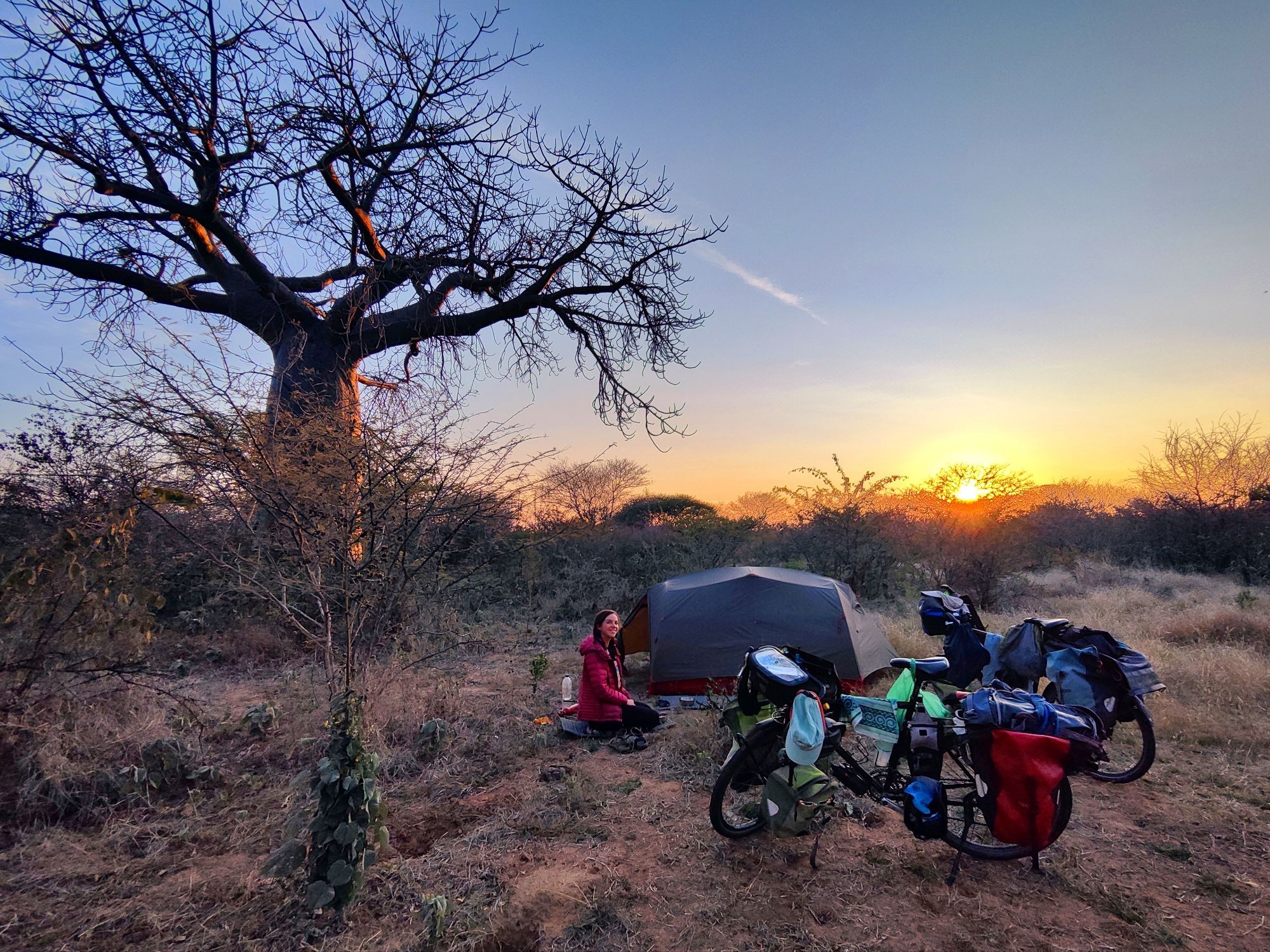
When we were planning our cycling trip in Botswana, it was hard to find information. So we wrote this quick guide for other travellers. Hopefully this will help!
About
Botswana is a wild and beautiful country. Thanks to its relatively peaceful history compared to other African countries, it’s considered very safe. It also has a low population (less than 3M) and a wide range of landscapes (desert, savannah, wetlands). But what makes Botswana truly special is its outstanding wildlife. While cycling, it’s not uncommon to see elephants crossing the road, and you might hear lions from your tent at night.

Geography
Botswana is very flat, but watch out for wind, which we mostly rode as tailwind from Francistown to Ghanzi. The south is semi-desert (Kalahari), the north more lush with wetlands like the Okavango Delta. Between Nata and Maun, you’ll also ride next to the Makgadikgadi salt pans.

Climate
Botswana has a semi-arid climate with hot summers (Nov-Mar) and dry, mild winters (May-Aug). We cycled in June: warm days, cold nights, and barely any rain.
Visa
90 days free for Swiss and most EU passport holder, USA and Canada.
Check your eligibility.
Beware: you might be eligible for 90 days on arrival, but the immigration officer may grant you a different number of days. Pay attention to the number written on your stamp — it is the actual number of days you’re allowed to stay.
I wasn’t aware of this and overstayed my visa by 5 days. Luckily, they just warned me to be more careful next time and let me go.

Money
The official currency is the pula (P). It’s mainly a cash-based country, but cards are accepted in bigger cities and at all major supermarkets.
SIM card
The 3 main retailers are BTC, Orange, and Mascom. To get a SIM card you’ll need to register with your passport by visiting one of the shops. The process takes about 45 minutes. We bought 30G of data for 200P (15$) with BTC.
Food
The local staple is maize starch (or pap), and you’ll find it almost everywhere. A typical meal of meat and pap costs 25-35P.

A must-try is magwinya (or “fat cake”), a fried ball of dough, best enjoyed warm. It’s very cheap, 1-2P.
A supermarket grocery run for 2 days worth of food runs around 150P, and a small bag of vegetables costs 10-20P.

We found that cooking our own food is slightly more expensive than eating at the local restaurants, but it’s not always an option, as towns can be quite far apart.
Water
Tap water is drinkable everywhere, or you can find purified water stations.
Accomodation
A double room would cost around 600P on average, while camping would be 70 – 150P pp.
Wild camping is easy, just watch out for wild animals, especially between Nata and Kasane.


Roads
Botswana has few roads. When we rode in June 2026, there were major roadworks between Francistown-Nata-Kasane, which brought some chaos. Most major roads are in OK condition, often with a reasonable shoulder, and traffic was respectful. Smaller roads can get really sandy.


People
We found people to be extremely nice and relaxed here in Botswana. Most were curious about our trip and wanted to make sure everything was ok. Their main concern seemed to be wild animals!

Language
Although English is an official language and is widely spoken, most people speak Setswana in their daily lives.
A few words to get by:
Hello (mam / sir) = Dumela (mma / rra)
Thank you = Kia lemboga
Goodbye = Tsamaya sentle
Highlights
The elephant highway (A33 Nata to Kasane)

Nicknamed the elephant highway, the 300km-long tarred road that connects Nata to Kasane was an absolute highlight for us. As the name suggests, this region is home to one of Africa’s largest populations of elephants. What is truly wild about this is that the region is unfenced, so elephants roam around freely. It is not uncommon to see herds of elephants crossing the road, or just chilling nearby.
Beware, elephants can be dangerous and you should be very careful when passing them. See this video from Kino Yves to get an idea of what awaits!
But elephants are not the only creatures that live in the area: giraffes, antelopes, zebras, hyenas and even lions can be seen here.
While it is not too dangerous to cycle during the day, it is best to be careful at night, when hyenas and lions are most active. This is why most cyclists choose to sleep in secure locations. Paying options include campsites and guesthouses, but it is also possible to find free spots. We slept within the fenced area of a telecom tower, and also in an abandoned building. Check iOverlander to find spots.
We cycled this road in both directions (we visited Victoria Falls nearby), and really loved it.
Sunset cruise in Chobe National Park


Arguably not cycling, but still a highlight for us! We booked a sunset cruise with Elephant Trail Guesthouse and Backpackers in Kasane. It cost us about 450P per person but was definitely worth it. We saw crocodiles, hippos, buffaloes, and a group of elephants bathing in the river.
Exploring the delta in a traditional Mokoro


Still not cycling, but also a great experience. If booked directly with the Okavango Kopano Mokoro Community Trust office in Maun, a guided day trip in the delta costs about 360P per person, including entry fee.
The tricky part is that the tours depart from local villages close to the delta (such as Boro 2). The road to the villages is very sandy and has no public transport. Be prepared to book a pricey transfer, hitch a ride, or push your bicycle through the sand for a few kms (which we did!). A fun experience regardless.
Makgadikgadi Salt Pans
When we were there in June 2026, the salt pans were flooded, so we didn’t visit. But it’s definitely something to check out in the dry season. A good entry point is Nata Bird Sanctuary. There is an entry fee.
Touristic attractions in Botswana
Quick note on touristic attractions in Botswana: they tend to be pricy, because the country caters mainly to an upscale clientele. Activities are often conducted with a guide and a private vehicle.
Our route
Looking for a self-guided route?
Check out our 9-Day Self Guided Route through Botswana
Additional ressources
Lewi Blake – Riding and camping
with Elephants
(Bikepacking Botswana)
Leave a Reply