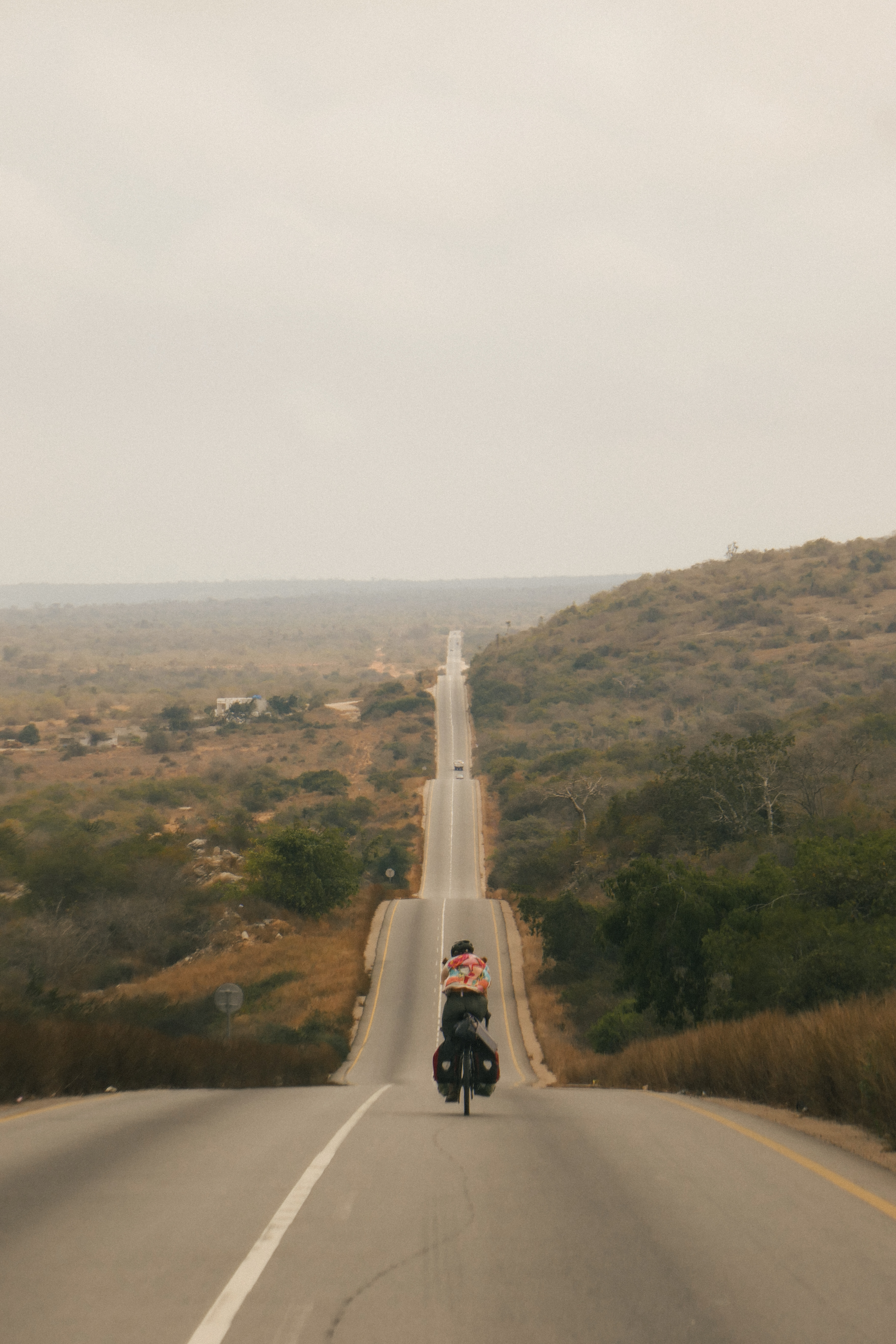
Here’s a quick guide to cycling in Angola, with lots of practical info if you’re thinking of visiting this little-known country.
About
Angola is a huge country with landscapes for every taste: desert, highlands, ocean and tropical forest. Add in top attractions with hardly a soul around, warm and friendly locals, and a laid-back vibe, and you’ve got a destination that’s well worth the ride.

Geography
The south of Angola is dry and desert-like, whereas the north is more lush and green. Running parallel to the coast is a belt of hills and mountains, followed by a large plateau at an altitude of 1,000 to 2,000 m.

Climate
Angola’s climate varies by region: the north and Cabinda are hot and humid with heavy rainfall, the coast is semi-arid (turning to desert in the far south) with mild temperatures year-round, and the Central Highlands (1,000–1,800 m) are temperate, with pleasant summers and chilly winter nights (July–August) that can approach freezing.
For more details, see
Angola Travel Guide and
Blue Green Atlas.

Visa
For most passports, Angola offers a visa-free option for 30 days, or an e-visa (30 days, extendable twice, for up to 90 days in total).
Money
The local currency is the kwanza (Kz). You can pay by Visa (but not Mastercard) in some larger shops. ATMs are readily available (Visa and Mastercard), with some queuing at the beginning and end of each month, when people get paid. The maximum withdrawal is 60,000 kwanzas (around €50). It is quite common that ATMs run out of notes in Angola, so be prepared!

SIM card
Getting a SIM card is relatively easy: you’ll need to visit a branch of your carrier of choice and register with your passport. The country has reasonable coverage, and you’ll find the signal is better near the many transmission towers. The carriers in Angola are Unitel, Africell and Movicel.
In August 2026, we got a Unitel SIM card and paid 15,000 Kz for 20 GB.
Food
A standard meal would be grilled fish or meat with rice or funge (cassava paste), with beans on the side.

There are also lots of padarias (bakeries) in Angola, where you’ll find freshly baked bread!

Typical snacks include grilled peanuts with sugar, plantain, cassava and fried dough dipped in sugar.
Markets and supermarkets are good places to stock up on food for the more remote stretches.
Coffee lovers will be happy to find good espresso too, and pastries are quite common, thanks to the Portuguese heritage.

Water
Some villages have a well, and most petrol stations have water too. Not all villages seem to have access to water, especially in the south. Bottled water can be found in most places. We were never more than 50 km from a water supply.
Accommodation
A basic double room typically costs between 10,000 and 25,000 Kz. Most basic rooms consist of a bed, AC, an old TV, and a bathroom (with warm water if you’re lucky!).
Wild camping is also quite easy, with many opportunities to sleep in nature. Don’t miss the marina in Luanda, which offers free camping to cyclists! See iOverlander for more details.
While wild camping is quite easy, there are almost no official campsites.

Roads
Most roads in Angola are in good condition. Traffic is relatively light in general, except around Luanda and other large cities. There are lots of motorcycles in Angola, so drivers are generally used to sharing the road with two-wheeled vehicles.

People
Angolans are friendly, curious and fairly relaxed. The population is very young, partly because of the civil war that shook the country from 1975 to 2002.
You will often be greeted by the ever-present “Amigo!”, and children running excitedly after your bicycle is not uncommon. The excitement might get a little intense at times, be prepared to be the center of attention.

In the south, especially around Namibe, you may meet the Mucubal people, who still follow a traditional way of life and have a striking appearance.
Language
The official language is Portuguese, and almost everybody speaks it. Very few people speak English, and some people speak French as you get closer to the Congolese border in the north. Also note that around 46 other languages are spoken in the country, mostly Bantu languages.
Highlights
Relics of War in the South
Abandonned tanks can be found close to the Namibian border, on the EN105, north of Ondjiva. They are relics of Operation Protea, a military action carried out by South Africa in 1981. They serve as a reminder of Angola’s darker past, when the country was in civil war.

Baobab Country
The Cunene region is home to massive baobabs, especially along the EN105 near Xangongo. You can cycle for many kilometres and marvel at these giants.

Serra da Leba
Angola’s iconic winding mountain road, with a series of tight hairpin bends that drop down from the Huíla plateau towards the coastal plain near Moçâmedes (Namibe). Whether you ride it up or down, it is a real highlight for cyclists, and the views are spectacular. Don’t miss the chance to wild camp at the nearby viewpoint! Check iOverlander for details.

Miradouro da Lua
Miradouro da Lua means “Moon Viewpoint” in Portuguese, and the name fits: the eroded cliffs and ridges create an otherworldly, almost lunar landscape. Located 60 kilometers south of Luanda, the viewpoint is currently under construction, but it is still possible to stop by and have a look.

Calandula falls
Located 300 kilometers east of Luanda, Calandula Falls are Africa’s second-largest waterfall by volume, after Victoria Falls. Amazingly, there is no entry fee, and you don’t need a guide to visit (although many will insist on accompanying you). There are absolutely no fences, so you can get as close to the edge as you like! You can also camp for free at the nearby restaurant, which has the best view you could ask for.

Pungo Andongo (Pedras Negras)
Pungo Andongo, also known as the Pedras Negras (“Black Rocks”) makes a good combination with the Calandula Falls, as it is nearby. These giant dark rock formations are millions of years old. You can wander between the rocks and even camp there. The entry fee is about 800 Kz per person.
If you’re riding there from Luanda, we recommend following road EN321-322, a prettier, less busy road than the EN230.

Crossing the desert from Moçâmedes (Namibe) to Benguela
As of 2026, the road connecting Lubango to Benguela via Namibe is brand new, except for a 50 km section of unfinished, pretty bad gravel road. For this reason, it is not very busy, and most of the ride along the coast and through the desert is beautiful. It is also a unique opportunity to see the Mucubal people, a pastoralist group who still follow a traditional way of life.

Free camp in the heart of Luanda
Luanda is a very modern capital, with cafés, restaurants, and malls. You can stay at the Clube Naval de Luanda, where cyclists can camp for free, with a great view of the city. Walk along the promenade and enjoy the perks of the city, such as the cheap cinema at the nearby mall!

Our route
Additional Resources
https://gonebikeabout.com/angola/
https://blog.tracks4africa.co.za/what-its-like-bikepacking-angola/
https://youtu.be/4QSmRYQBfN4?si=cb2rxbJ17SXpQT6j
Leave a Reply